
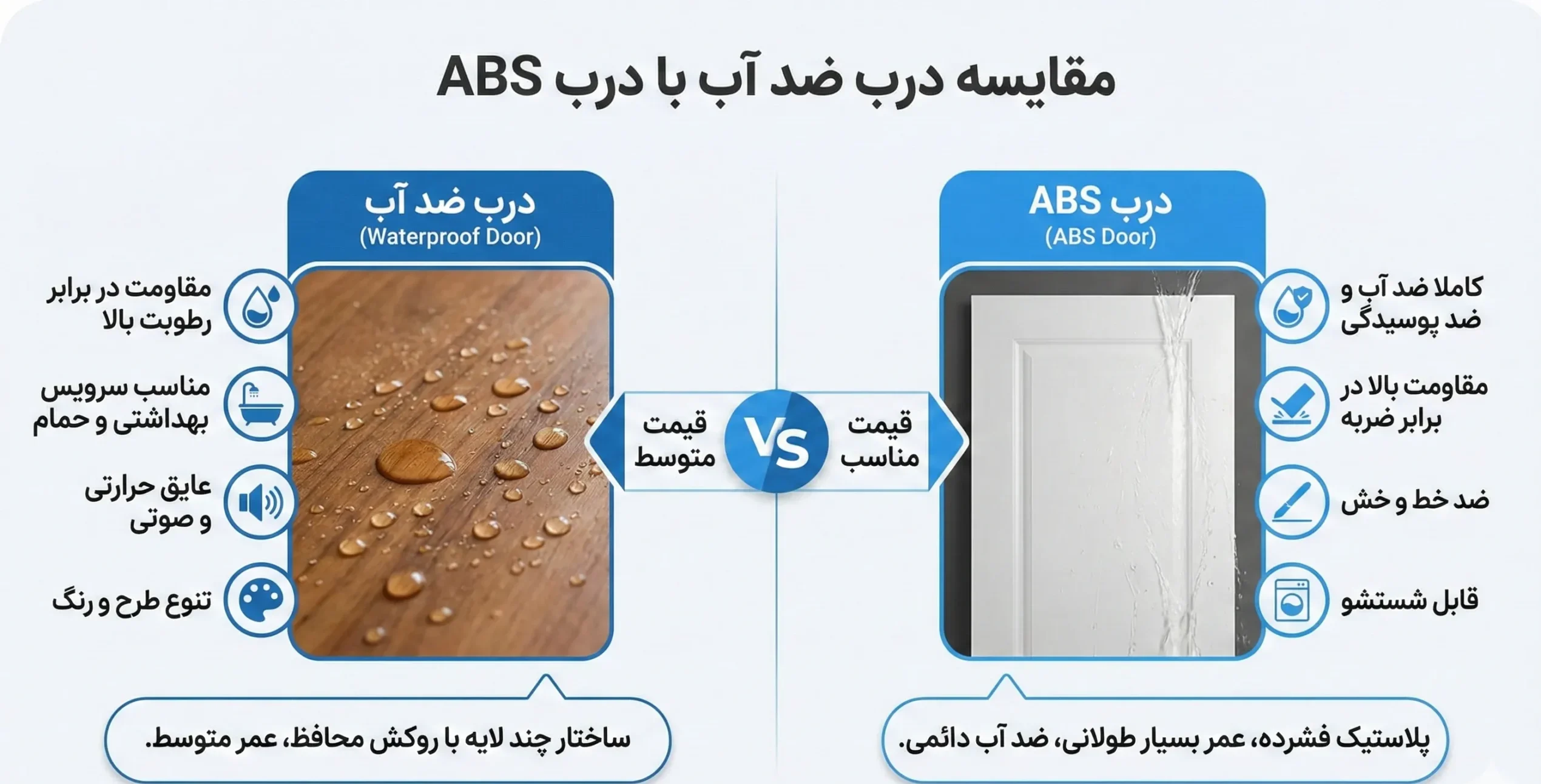
Comparison of waterproof door with ABS door One of the best ways to make an informed choice is in wet spaces. Waterproof door It is designed to be completely resistant to moisture, steam, and continuous washing, and provides effortless and long-lasting performance for bathrooms, toilets, and kitchens. On the other hand, the ABS door with its polymer coating has good resistance to water and impact and is considered an economical and practical option for semi-humid spaces. The difference between these two doors is in their structure, resistance and lifespan; Where the right choice determines the quality of everyday use.
- Comparing waterproof doors with ABS doors: a selection guide for bathrooms, services and wet spaces
- Structure and raw materials: what is behind the name "ABS door" and "waterproof door"?
- Moisture resistance and performance in humid environments
- Impact resistance, durability and maintenance tips to increase useful life
- Price, weight and installation: how budget and installation conditions determine the choice
- Technical comparison table: key features of ABS door against common waterproof examples
- Practical tips for smart purchase and installation
- A choice that will keep you comfortable for years: the smart decision between an ABS door and a waterproof door
In the meantime, Rasta Choob as a manufacturer of all kinds of doors ABS waterproof door From various internal models, it is a safe choice for professional buyers. Rasta Choob uses high quality materials, up-to-date design and strict production control to provide you with products that are both durable and aesthetically pleasing. If you're looking for a derby that will last years of trouble-free operation and is worth the splurge, the Rasta Choob is where an informed choice becomes a smart purchase.
Are you confused by choosing the right door for your bathroom and toilet? In this practical guide, instead of general slogans, structural, functional and cost differences of waterproof doors and ABS doors are examined so that decisions can be made based on the reality and needs of the project. The manufacturer's experience, along with installation and maintenance technical tips, will help you balance economic choice and long-term investment.
Comparing waterproof doors with ABS doors: a selection guide for bathrooms, services and wet spaces
Being accurate in choosing a door for wet spaces requires technical knowledge, and this article compares waterproof doors and ABS doors in a practical way so that buyers and contractors can make an informed decision. As a manufacturer of all types of doors, Rasta Choob produces various models according to the needs of residential and commercial projects, and in the following technical explanations, the experience of the manufacturer has been used to provide implementation tips. Accurate understanding of structural and functional differences prevents incorrect selection and premature replacement costs.
Structure and raw materials: what is behind the name "ABS door" and "waterproof door"?
The ABS door consists of a combination of three main monomers, acrylonitrile, butadiene and styrene, which creates a resistant plastic coating and minimizes moisture penetration if a complete vacuum is produced. On the other hand, the term "waterproof door" includes several categories of materials; including polywood (WPC), UPVC, fiberglass (GRP) and foamed samples, each of which has a different core and cover.
MDF or chipboard cores in ABS doors are usually covered with ABS veneer, and if the veneer is damaged, the wooden core can absorb water and swell; But plywood and fiberglass core doors have a combination of polymer and fibers, which by themselves show higher resistance to water. In the production process, the quality of gluing the coating, the use of polyurethane sealants and the continuity of the sheets determine the final resistance against water penetration.
Moisture resistance and performance in humid environments
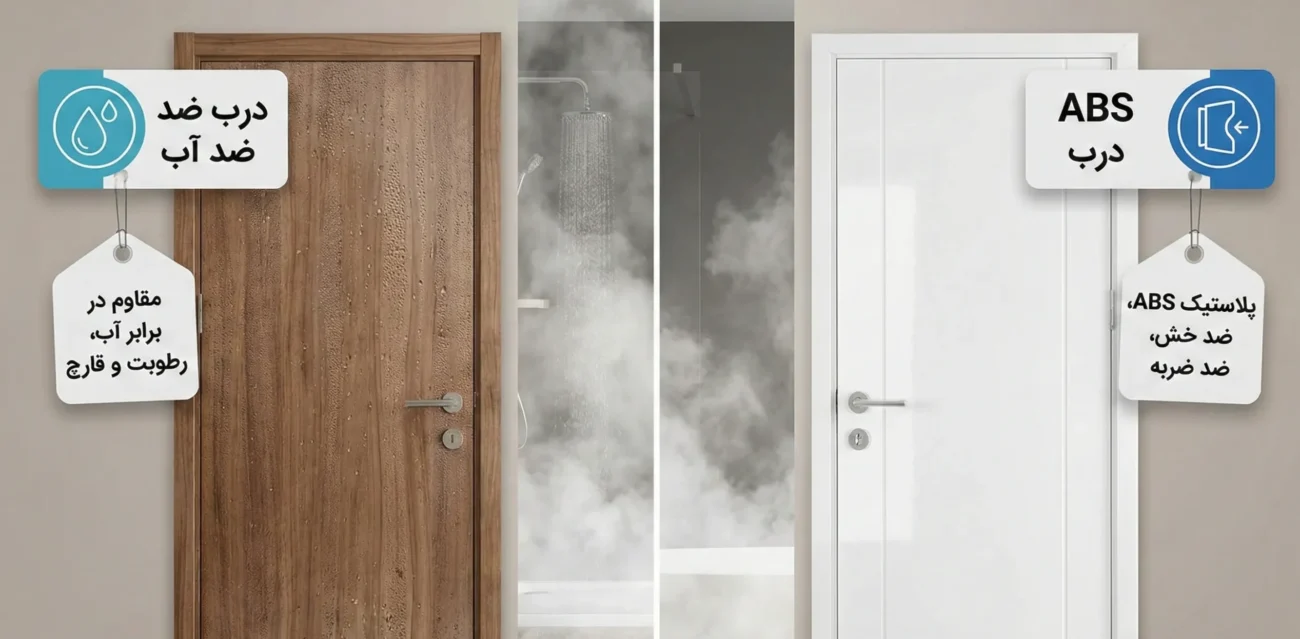
The standard ABS door has good resistance against splashing and environmental humidity and is considered an economic option for normal use bathrooms; However, if the cover is scratched or torn, the inner part may show swelling. Polywood doors are more resistant to repeated wetting, washing and steam due to the combined fiber-polymer structure and are more suitable for spaces with a lot of drainage.
Fiberglass (GRP) and UPVC samples are also more practical for swimming pools, hospital uses and cases that require frequent cleaning, and deformation or decay occurs less often. Rasta Choob offers plywood and fiberglass options in its waterproofing products for projects that are exposed to direct water, and advises customers to review actual work in the same conditions.
Impact resistance, durability and maintenance tips to increase useful life
ABS is known as a tough and relatively impact-resistant material, but the thin plastic coating can be damaged by heavy impact or contact with a sharp object; Therefore, in high-traffic places where there is a possibility of frequent collisions, a more resistant material may be needed. Polywood and fiberglass doors show higher mechanical resistance and are preferred in projects where safety and durability are a priority.
Simple care and maintenance such as cleaning with mild detergents, avoiding contact with strong chemicals, and checking the fittings annually can significantly extend the life of the door. Rasta Choob offers after-sales service and a limited warranty to cover manufacturing defects, which you must coordinate with the sales department for the scope of coverage and installation conditions before purchase.
Price, weight and installation: how budget and installation conditions determine the choice
In economic comparison, ABS door is usually the most cost-effective option under the condition of full vacuum production, and due to its light weight, it has a quick and easy installation, which also reduces the installation cost. On the other hand, plywood and fiberglass doors have a higher initial cost, but in the long run, they are seen as a rational investment due to their longer lifespan and reduced need for replacement.
When buying, in addition to the base price, you should include things such as the cost of transportation, installation, frame, fittings and side insulation in the financial estimate. Rasta Choob allows for custom manufacturing based on customer dimensions and designs and offers segregated pricing for product and installation so contractors and owners have cost transparency.
Technical comparison table: key features of ABS door against common waterproof examples
| Feature | ABS door | Polywood (WPC) | UPVC / GRP |
|---|---|---|---|
| Moisture resistance | Very good in vacuum; Sensitive to coating damage | excellent; Resistant to wetting and washing | excellent; Suitable for frequent washing and outdoor use |
| Impact resistance | Good, but the cover may show some tears | very good Stronger structure | Good to very good depending on thickness |
| Weight | Low and easy to install | Medium to heavier | Light to medium |
| price | Economy to medium | Moderate to more expensive | Moderate to more expensive |
| Washable | Washable but sensitive to scratches | Washable and resistant | Washable and suitable, but need to be careful in connections |
| Estimated lifespan | Good in good production condition | long It changes shape less | long Suitable for high traffic and wet areas |
| General offer | For limited budget and low traffic spaces | For humid environments with frequent washing | For specialized applications such as swimming pools and hospitals |
For the final selection, it is important to pay attention to the type of core, coating quality, installation method and warranty scope, and Rasta Choob clearly declares these parameters in the product catalog and the installation contract.

Practical tips for smart purchase and installation
Before placing an order, measure the exact dimensions of the installation location and the ventilation condition to minimize the risk of swelling or mold growth; In places with poor ventilation, even waterproof doors need more care. Ask the seller to guarantee in writing the type of core, the thickness of the coating and the method of sealing the sides, and in the installation contract it is specified that standard sealants and fittings are used. If your project involves public or high-traffic areas, investing in plywood or fiberglass will reduce future repair and replacement costs. Rasta Choob provides the possibility of sampling and visiting local samples so that the customer can check the final quality in real conditions before purchasing.
A choice that will keep you comfortable for years: the smart decision between an ABS door and a waterproof door
In a practical view, the choice between ABS door and waterproof door should be based on usage pattern, risk of direct contact with water and long-term budget. If you have a low-traffic space and need an economical option, the ABS door with standard vacuum production can reduce the initial cost; But for spaces with frequent washing, steam, or water contact, materials like plywood or fiberglass really cut down on maintenance costs.
Next practical steps: (1) ask the vendor for a real sample in the same condition as the project; 2) request in writing details of core, cladding thickness and sealing method; 3) check the ventilation and frame details before installation and specify in the contract; 4) Calculate the cost of the entire life cycle including installation, maintenance and replacement. By prioritizing the quality of the coating and the correct sealing, you can increase the useful life several times and avoid unexpected costs. An informed choice not only optimizes the cost, but also ensures the peace of use of the wet space for years.
How useful was this article?
1 --- 5
Average rating 4.8 / 5. Number of points 427
No points have been registered so far. (be the first)