
In modern architectural projects, choosing between different door systems can have a direct impact on light, privacy and beauty of the space; in the meantime, The difference between the door Frameless and Decofix It can be seen more in the way of execution, the degree of integration with the wall and their visual style, so that frameless is known for its minimal design and no visible frame, and decofix is more decorative and framed. In this area, Door production Frameless Relying on accurate design and standard material, it plays an important role in improving the final quality of projects.
- The difference between Frameless and Decofix doors: a professional selection guide for architects and builders
- Rasta Choob as a manufacturer of all types of doors and the role of the manufacturer in the quality of execution
- Technical structure and material: key differences between frameless and decofix
- Design and aesthetics: where frameless is more suitable and where decofix excels
- Operation, installation and maintenance
- Cost, standards and implementation tips for employers and contractors
- How to choose between frameless and decofix: decision criteria
- beyond appearance; Technical and operational review of frameless and decofix doors
Also Frameless door manufacturer By offering various models and customization capabilities, it enables architects and project managers to make the best choice for residential and commercial spaces based on technical and aesthetic needs.
This introduction sheds light on key technical, aesthetic, and cost considerations, and shows how the choice of materials, type of fittings, and the role of the manufacturer—including the hands-on experience of companies like Rasta Choob—improve the bottom line. In the following, you will find comparison tables, decision guides and implementation tips so that you can choose the most suitable option for your residential and commercial projects; Whether you are looking for transparency and modernity or looking for insulation and decorative texture. The following materials are dedicated to finding a comparison of specifications, advantages and disadvantages for purchase or installation and checking the technical, appearance and price differences step by step and with examples.
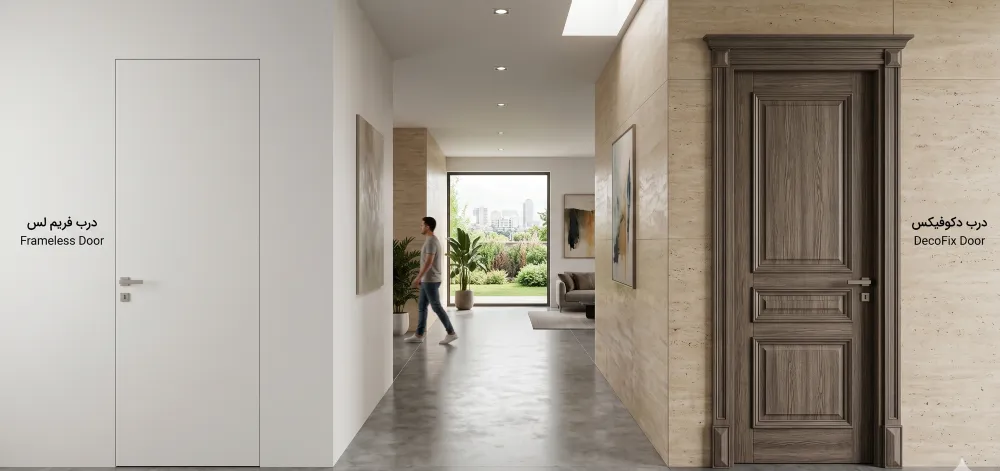
The difference between Frameless and Decofix doors: a professional selection guide for architects and builders
Frameless doors and Decofix systems are two different solutions for covering and dividing space in modern architecture, and knowing the advantages and limitations of each helps to make the right decision in residential and commercial projects. This text examines the technical, aesthetic, installation and maintenance, and practical aspects so that the audience can make an intelligent choice between the two options based on the needs of the project.
Rasta Choob as a manufacturer of all types of doors and the role of the manufacturer in the quality of execution
Rasta Choob, as a manufacturer of all kinds of doors, including frameless and decofix doors, has experience in production and installation in domestic and urban projects, and this experience is reflected in the selection of materials and execution details. Reputable manufacturers such as Rasta Choob can provide quality assurance, after-sales service and compliance with safety standards by providing standard and customized samples.
When the manufacturer is involved in the design and production stages, it is possible to match exact measurements, choose the right fittings, and provide better fireproofing or sound insulation solutions; The item that Rasta Choob considers in its business projects and can provide the necessary technical documents for administrative processes and approvals.
Technical structure and material: key differences between frameless and decofix
The frameless door is generally executed as glass panels or a combination of wood and glass, with no metal or wooden frame around the viewing surface, thus providing a unified and minimal appearance. Decofix is known as a system attached to the edges or with a special fitting that keeps the panel hidden in the frame and is usually used to install wooden doors with decorative details.
The choice of material in frameless focuses more on tempered glass, laminate or light composites, and in decofix, the quality of MDF or HDF with natural finishes and hidden fittings is decisive. The strength of frameless is in the maximum display of light and open vision; Decofix, on the other hand, provides more space for applying decorative details and sound insulation.
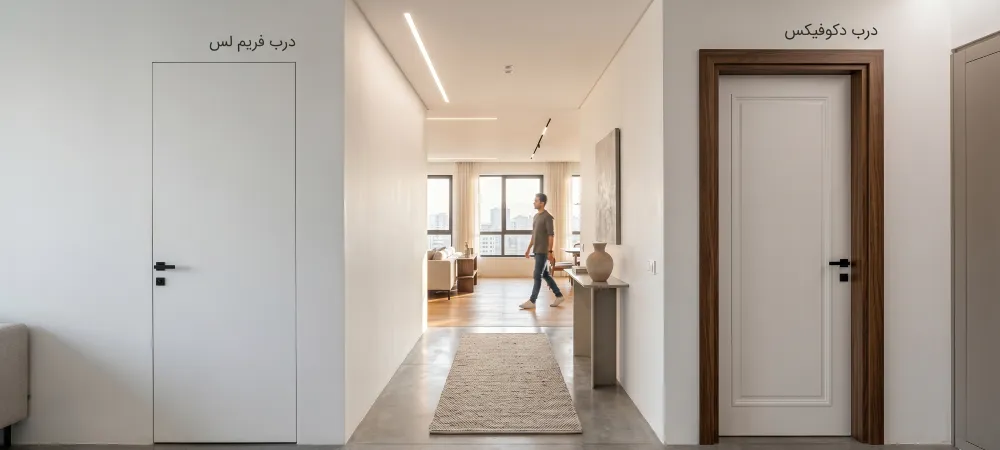
Design and aesthetics: where frameless is more suitable and where decofix excels
In spaces where there is an emphasis on light, transparency and continuity between two spaces, frameless is the best choice because the sight lines are not interrupted and it enhances the modern feeling. On the other hand, Decofix is suitable for spaces where the designer seeks to create texture, pattern or visual appeal by using wood veneers and hidden frames.
In office buildings and stores that need to combine visual display and open space, frameless helps to increase product visibility; For apartments and conference rooms where privacy and sound reduction are important, Decofix is a more practical option. Practical advice: in the renovation of central city apartments such as Tehran or Isfahan, the combination of frameless in the entrance and decofix in the interior of the rooms balances beauty and efficiency.
Operation, installation and maintenance
In terms of performance and installation, the differences are clearly seen in connection methods, structural requirements, and maintenance; The following table provides a systematic comparison so that the selection is made according to project priorities.
| Feature | frameless | Decofix |
|---|---|---|
| Connection type | Glass fittings, installation with structural adhesives and sometimes hidden rails | Hidden fittings on the edges, special hinges and inner frame |
| sound insulation | Lower except with multi-layer laminated glass | Can be reinforced with wooden cores and sealing strips |
| Need to maintain | Glass needs regular cleaning and fittings are sensitive to settings | Surfaces may require periodic varnishing or cleaning |
| Resistance to damage | It is more fragile against strong impact, but more resistant to moisture | Depending on the material of the core and coating, it has medium to high resistance |
| Ease of installation | It requires an experienced team to cut and install the glass accurately | Faster installation in workshop conditions and the possibility of more accurate assembly on site |
| Appropriate offer | Stores, lobbies and showrooms | Residential spaces, conference rooms and projects that require insulation |
Cost, standards and implementation tips for employers and contractors
The overall cost of frameless often depends on the price of the glass, its thickness and the need for special fittings, and in large store projects it can be more economical than building complex wooden frames. Decofix may cost less at first glance, but choosing a high-quality coating and standard fittings can change the final cost; Therefore, a detailed estimate of the contractor is necessary before the final decision.
From a standards perspective, both systems must comply with building safety, fire resistance, and local acoustic specifications; A manufacturer like Rasta Choob can provide technical documents and necessary certificates to designers to facilitate the project approval process in the municipality or supervisory organizations. Practical suggestion: before the final order, ask the manufacturer for real examples of similar projects and check the fit of the dimensions and performance of the fittings at the test installation site.

How to choose between frameless and decofix: decision criteria
To make the right choice, first determine the amount of lighting required, the level of privacy, the budget, and the project implementation time, and prioritize based on these four criteria. If the project is located in the city center and on commercial floors and the goal is to increase product visibility, prioritize frameless; If the goal is to reduce the noise and increase the strength of the doors, Decofix is recommended as a practical option.
For projects that have a combination of these needs, a hands-on custom manufacturing solution from an experienced fabricator like Rasta Choob can provide the best results, as it allows for project-based customization of materials and fittings. When finalizing the order, get installation, warranty and after-sales service documentation from the manufacturer to maintain quality performance over time.
beyond appearance; Technical and operational review of frameless and decofix doors
Look at the two options from a technical point of view: the frameless door is a tool for increasing light and visual continuity, and Decofix is a tool for increasing privacy, insulation and decorative texture. The professional decision revolves around four key variables, the amount of light, the level of privacy, the budget and the implementation time - the prioritization of which shows a clearer path to choose.
Your next practical steps should include requesting real samples, receiving technical specifications and warranty, calculating the total cost considering fittings and installation and checking the possibility of a combined solution at different points of the project. Don't be afraid of trial installation and sound insulation test or light show in real conditions; These tests reveal the difference between the ideal design and the final output.
Remember that the manufacturer's role in ensuring accurate dimensions, proper fitment and technical documentation is undeniable. Ultimately, the choice between the Frameless door and Decofix is about more than aesthetics or price, it's about the quality of experience that residents or users will face every day.
How useful was this article?
1 --- 5
Average rating 4.8 / 5. Number of points 464
No points have been registered so far. (be the first)