
Want to create a frameless derby that both looks elegant and stands up to everyday use? In this practical guide, Frameless door construction method We have explained in simple language and step by step for professional builders and buyers. Also with the standards and processes used in Door production Frameless You will get to know to have a better understanding of the stages of design, production and implementation of these types of doors. We start by choosing the right material and design criteria that ensure both stability and elegance, then we provide a complete list of materials and tools needed from MDF cores to CNC machines and installation equipment.
- Frameless door manufacturing method: a practical guide to producing frameless doors by Rasta Choob
- Design principles and technical criteria for Frameless doors
- Choosing the right materials: wood, composite and glass
- Practical steps and sequence of work in the door construction method Frameless
- Key tools and machinery for industrial production
- Quality control and standard tests before shipping
- Tips for installation, adjustment and after-sales maintenance
- The final steps to achieving a beautiful and sustainable Frameless door
In the following sections, experiences and standards used by Frameless door manufacturer We review to learn more about quality control criteria and professional execution. Chapters have also been compiled on pre-shipment quality tests, basic installation methods, and post-sale maintenance solutions so that the final product has a lasting and reliable performance. If you are looking for step-by-step instructions, material and tool lists, and practical tips for building or installing a frameless door, this article covers all your technical and practical needs. By fully reading this guide, you can choose the designs that suit your project and ensure professional implementation in accordance with industry standards in the shortest possible time.
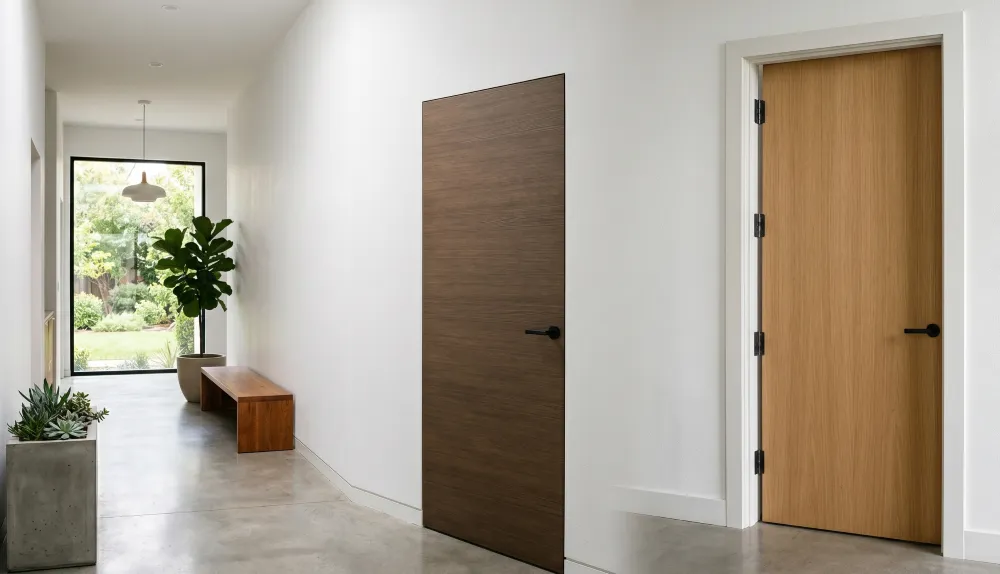
Frameless door manufacturing method: a practical guide to producing frameless doors by Rasta Choob
Rasta Choob company, as a manufacturer of all kinds of doors, Frameless door construction method by emphasizing the quality of materials and technical accuracy. This guide describes the manufacturing process from material selection to final installation and shows how Rasta Choob was able to offer a combination of minimal design and industrial durability. The aim is to provide guidelines of practical value to both producers and professional buyers.
Design principles and technical criteria for Frameless doors
In the design of the Frameless door, structural stability must be guaranteed without the use of a visible frame; For this reason, load calculations, selection of internal columns and distribution of fittings play a central role. Allowable thickness, type of hidden hinges and reinforcement points are specified in the initial design to prevent twisting and bending over time. Reflecting light, maintaining smooth lines, and harmonizing with surrounding architectural elements are also influential in design decisions, and every project must be executed based on detailed CAD drawings.
Choosing the right materials: wood, composite and glass
Material selection is one of the most important steps; Rasta Choob typically uses a combination of an MDF or HDF core with an engineered wood veneer or durable laminate to achieve a smooth, even surface. In designs that use laminated or tempered glass, hidden silicone covers and special rubber grooves are installed to absorb impact and prevent load transfer to the sides. For humid environments or exterior doors, the use of anti-moisture cores and Thermowood veneers or UV-resistant coatings is recommended to increase the useful life of the door.
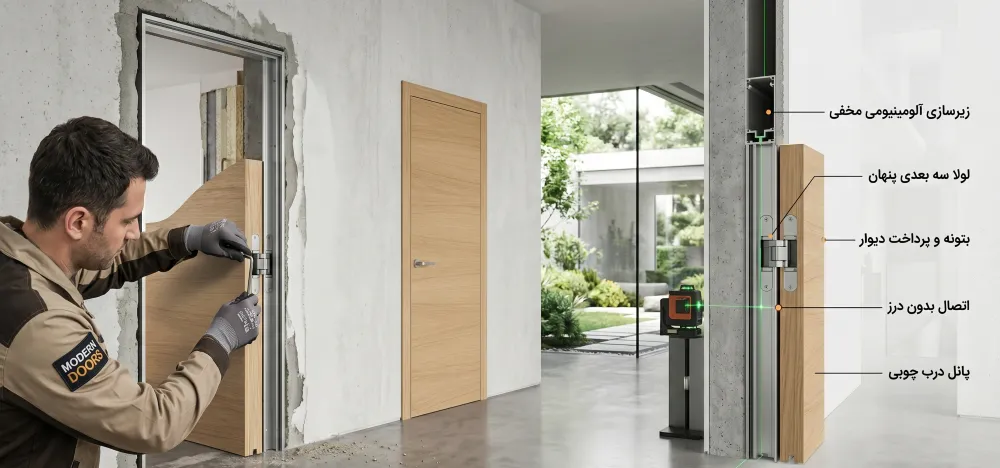
Practical steps and sequence of work in the door construction method Frameless
The manufacturing process begins with a blueprint review and initial core cutting, and the cuts are usually made with a CNC machine to ensure dimensional accuracy. After cutting, the core pieces are subjected to priming and press coating operations so that the glued layers get the necessary integrity. In the next step, the necessary grooves and pits for hidden fittings are cut and the reinforcement points are reinforced with engineered wood or structural foam.
Glass or interior panels are installed with structural adhesives and hidden fasteners, and then the edges are covered with special edge tape or rolled metal. Controlled sanding and final coating (polish paint, UV coating or special oil) are performed to make the surface homogeneous and resistant. Each stage is matched with a quality checklist and functional tests such as open and close test, impact resistance test and weathering test.
Key tools and machinery for industrial production
The multi-axis CNC machine for precision cutting and engraving is the main device in the modern production line; The accuracy of this device determines the quality of fittings. The vacuum press machine for pressing wood veneers or laminates requires accurate temperature and pressure control so that bubbles and separation do not occur. Edgebanding and edgebanding machines, double-layer sanding machines and UV paint lines or drying ovens are also essential parts to achieve an industrial finish. To perform hidden hardware installation and balance weight control, laser measuring equipment and adjustable leveling jacks are used to test and adjust each panel before packaging.
Quality control and standard tests before shipping
Before leaving the factory, each door must pass flexibility, impact and durability tests; Rasta Choob recommends the use of open and closed cycle tests to measure useful life. Dimensional control is done with digital measuring devices and surface moisture penetration test after applying the final coating to prevent the absence of leakage or holes. Also, samples for environmental tests such as temperature and humidity changes are placed in the simulation rooms to ensure that the product performs well in Iran's climatic conditions.

Tips for installation, adjustment and after-sales maintenance
Installing the Frameless door requires precise coordination between the opening of the frame and the panel itself; At the time of installation, special brackets and dowels must be used to transfer the load to the wall or column and spread it uniformly. Rasta Choob provides a dedicated installation manual for each project with hardware and recommends checking alignment distances with a laser level. For long-term maintenance, cleaning with a damp cloth and avoiding strong chemicals is enough, and if installed in direct sunlight, applying a UV protective layer every few years will increase the durability of the coating. Periodic adjustment of hinges and checking of side seals also prevent noise and dust penetration.
The final steps to achieving a beautiful and sustainable Frameless door
In a summarized view: success in making Frameless door starts from choosing the right material, strict production control and basic installation, and becomes a useful life with maintenance planning. What practical things to do now to get professional results:
- Determine the purpose of use (indoor/outdoor, wet/dry) and choose the right core and cover accordingly.
- Build a small prototype with CNC and run open and closed cycle tests and moisture penetration test to identify design weaknesses.
- Prepare a quality checklist including final dimensions, fittings, coating integrity and impact tests and implement them at each stage.
- During installation, prioritize laser alignment and carrier brackets so that the load is transferred correctly and twisting does not occur.
- Provide the customer with an installation manual and periodic maintenance schedule (checking seals, adjusting hinges, UV protection if needed).
This step-by-step approach not only gives the door a minimal look, but also ensures that functionality and durability go hand in hand with beauty. A successful Frameless door represents intelligent design; A beauty that goes beyond appearance and proves quality in action.
How useful was this article?
1 --- 5
Average rating 4.8 / 5. Number of points 467
No points have been registered so far. (be the first)